Skip to content
PLATFORM · EDR for AI — endpoint and server control →
AI Security Posture Management

Discover and control enterprise AI. From endpoint to cloud.

Find AI agents, MCP infrastructure, keys, models and data paths across macOS and Linux, with Windows and Windows Server in beta, plus live AWS cloud discovery — with Azure and Google Cloud connectors on connect. Prioritize real exposure, govern approved-AI policy and stream governed evidence to your SOC. The discovery sensor is observe-only.

Windows·Windows Server beta·Linux·macOS·AWS Azure/GCP on connect |self-contained native sensors · eBPF on Linux
GLOBAL ESTATE — REPRESENTATIVE TELEMETRY LIVE
The AI Control Loop

One continuous loop — evidence flows, and the loop never stops.

Discover shadow AI, place it in context, respond by real risk, test it before it ships, watch it at runtime, and govern it for conformity — then feed what you learn straight back into discovery.

CONTINUOUS · WHAT YOU LEARN FEEDS DISCOVERY 01 · DISCOVERDiscoverEndpoint & cloud AI 02 · CONTEXTContextGraph · identity · data 03 · RESPONDRespondScore · threat intel 04 · TESTTestSupply · red-team · CI/CD 05 · RUNTIMERuntimeExecution traces (AIDR) 06 · GOVERNGovernEU AI Act · policy
Explore the full loop →46 verified capabilities
Sensor-led cloud CSPM

See what a running AI agent could reach before it becomes an incident.

The workload sensor supplies process, tool-scope and metadata-service context. A read-only AWS connector adds effective identity, policy and storage posture today, with Azure and Google Cloud connectors on the way. Araghatta correlates both into an evidence-backed attack path—without harvesting credentials or exploiting the environment.

01 · RUNTIMERunning AI agentProcess, service, container, owner, unattended state and available tools.
02 · HOSTReachable preconditionsMetadata-service mode, network reachability and workload boundary.
03 · IDENTITYEffective permissionsInstance role, managed identity or service account and privilege edges.
04 · DATAReachable servicesAmazon S3 today (Azure Storage and Google Cloud Storage on connect) and other sensitive resources.
05 · ACTIONPrioritised remediationBreak the shortest path, route evidence and verify the fix.
Traction — not a concept

Built and proven on real client engagements — delivered through two partners across multiple clients.

Client names are held under NDA. We'll walk you through the real engagements and provide references in the meeting.

Why now — industry data, not our metrics
+$670K
Added to the average breach cost when shadow AI is involved — and 1 in 5 breached orgs had a shadow-AI breach.1
34.8%
Of the corporate data employees put into AI tools is sensitive — up from 10.7% two years earlier.2
86%
Of organisations have no visibility into how data flows to and from the AI tools their people already use.3

Sources: 1 IBM, Cost of a Data Breach 2025 (63% of breached orgs lacked AI-governance policies). 2 Cyberhaven, 2025 AI Adoption & Risk Report. 3 Reco, State of Shadow AI. Methodology and further sources in our research.

Discover

Eleven signal classes where shadow AI hides.

Network traffic is only one of them. One lightweight sensor sweeps every endpoint — and mobile, and cloud servers — because the coding agent installed from a website, the API key in a shell profile, or the MCP server wired into an IDE never shows up in a firewall log.

Network & egress

Outbound calls to LLM APIs and agent web apps — matched by hostname (DNS/SNI), not shared CDN IPs.

real-time · eBPF (Linux)

MCP servers & tool scope

Every MCP server with its package, version, source repo — and the exact fs / shell / network tool scope it was granted.

provenance · privilege

API keys & secrets

Provider keys in env, .env files, and shell profiles — the strongest proof of use. Fingerprinted, never exfiltrated.

highest signal

AI CLIs, apps & SDKs

Desktop LLM runtimes, coding-agent CLIs, and import openai-style SDK use in running code.

on-device

IDE AI assistants

Copilot, Cursor, Cody, Continue, Amazon Q — installed as IDE plugins, with the signed-in account and version.

by marketplace ID

Skills files & agent skills

Downloaded SKILL.md and agent skills — executable instructions, tied to their unverified source repo.

provenance

Vibe-coded repos

Repositories where AI wrote the code — Cursor / Copilot / Claude footprints reaching production without review.

by project

Autonomous agents

Orchestrators running with AI — LangChain, CrewAI, AutoGen, MCP loops — flagged when they run unattended.

behaviour

Browser extensions

Every extension enumerated by stable ID — AI assistants flagged, nothing quietly filtered out.

by ID

Mobile AI apps

AI apps discovered on iOS and Android — by account type — for the devices your fleet forgets.

mobile

Cloud-server CSPM

Correlates a running AI agent with metadata-service posture, effective workload identity, reachable storage and cloud-service configuration. Findings model plausible exposure paths without requesting credentials or exploiting the workload.

CSPM
Intelligence

Two scores, not one — and a threat feed that never sleeps.

A full inventory is table stakes. The hard part is telling your team what's actually dangerous, keeping that judgement current as the world changes, and catching the agent that goes rogue on its own.

Risk + threat

Score the threat, not just the risk.

Two independent severities, each on its own capability-specific rubric: operational risk — "how bad if misused" — and active threat — "how likely and dangerous is exploitation right now." ChatGPT on 200 laptops is high risk, low threat; one malicious MCP server is the reverse. Your team works what's dangerous, not just what's numerous.

Continuous AI threat intel

New AI threats, matched to your fleet.

A background engine pulls live vulnerability intelligence — NVD, CISA KEV, OSV — plus curated agent TTPs, and correlates it against your real inventory. "You run Vercel AI SDK vX — it matches this flow CVE." Every exposure carries the real-world AI incidents behind it — Hugging Face malicious models, ShadowRay, torchtriton — so your team sees not just the CVE but how it has already been used. New high or critical exposures alert the affected team on Slack and email, same cycle.

Rogue-agent detection

Catch agents that go rogue.

Unattended orchestrators with code-exec, network and live credentials; unexpected HuggingFace model pulls; confused-deputy MCP abuse; skills loaded from unverified repos — detected on the host, mapped to MITRE ATLAS & ATT&CK, and alerted on the next collection cycle — sub-second on Linux via eBPF.

Reasoning engine

From a finding to a proven attack path.

Anyone can list the AI on your fleet. The hard part is deciding what's actually exploitable here, and showing how a handful of small problems become a breach — in plain language your board can follow.

AI bill of materials

Every AI library, matched to real CVEs.

A true AI-BOM: each third-party AI library and its exact installed version, matched against live OSV, NVD and CISA-KEV feeds — real advisories with real severity and the fixed version, not a guess. You see the library, the CVE, and whether a patch exists.

Host-aware severity

Is it really Critical — on this machine?

The same CVE isn't equally dangerous everywhere. Our AI re-weights each advisory against what the host actually presents — is the vulnerable library even loaded, is there a live credential, an autonomous agent, no EDR — and tells you whether it's truly Critical or effectively Medium here, with the reasoning and the exploit pre-conditions shown. Advisory only; it never overwrites the official CVE.

Attack chains

How a few mediums become a breach.

An executive view of how small findings chain — a reused key, an outdated library and a missing EDR become foothold → credential theft → privilege escalation → lateral movement → data exfiltration. The connected device → agent → MCP → credential → egress path, with a step-by-step "how this attack happens." Reasoned from what we observed — never exploited.

Platform

Discovery is table stakes. This is what you do next.

Ten stages, one platform — from seeing an asset to deciding on a leak. Built like an EDR, not a scanner script.

01
Discover
Inventory every AI asset across the fleet
02
Assess
Risk engine + AI vulnerability & provenance KB
03
Prioritize
Scored, explained risks + a posture trend
04
Govern
Sanctioned-vs-shadow policy; approved tools muted
05
Attribute
Tie risk to a person; catch offboarded access
06
Prove
Auto-mapped compliance evidence + AIBOM
07
Integrate
Push to SIEM · Jira · Slack
08
Detect
eBPF real-time exec & connect tracing (Linux)
09
Protect data
Content-DLP policy engine — decide block, redact or warn per class
10
Respond
Remote-pause or revoke a compromised device, alert, and export signed evidence
The console

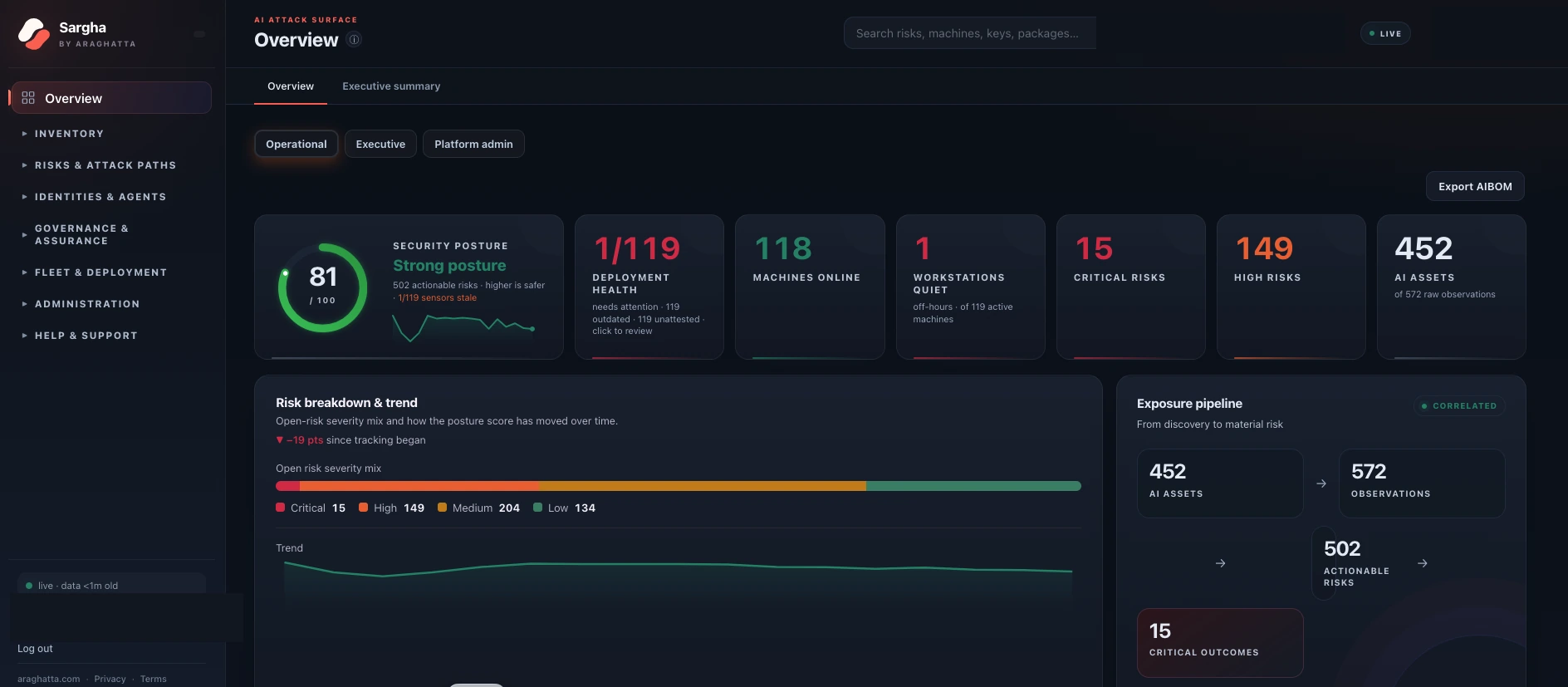
One AI-risk score across every machine reporting in.

Risks are scored, explained, and ranked — vulnerable MCP versions, typosquats, secrets, unverified provenance — each with the machine, the person, and the fix attached.

app.araghatta.com — risks
88
AI risk score
2
Critical
5
High
3
Sensors online
All risksVulnerabilitiesSecretsProvenanceBlast radiusEgress
SeverityClassRiskMachineOwnerStatus
criticalTyposquat@modelcontextprotocol/server-filesystemWIN-4471j.smithopen
highVulnerableserver-filesystem@0.3.1 · SHAI-2026-001MAC-0192r.patelopen
highSecretPlaintext Anthropic API keyMAC-0192r.patelopen
mediumProvenanceSkill from github.com/randomuser/pdf-skillsLNX-0088k.chenopen
infoSanctionedClaude Code (approved)MAC-0192r.patelsanctioned

Illustrative console view — sample data, not a real customer's fleet. Book a demo to see it on your own. (For findings from real engagements, see customer engagements.)

Policy & response

From a finding to a governed decision — with an audit trail.

Detection is table stakes. Araghatta adds a server-side content-DLP policy engine and a console response channel, so a finding becomes a governed decision — not just another alert. The endpoint sensor stays observe-only; enforcement is opt-in and fully audited.

Content-DLP policy engine

Classify it, then decide — block, redact, or warn.

Submit content to the inspection API and the policy engine classifies secrets, PII, PCI (payment-card) and PHI (health) data, and source code, then returns a per-class decision — block, redact or warn — with a monitor-first rollout mode, set per tenant and per crown-jewel machine. It reasons about AI context a generic CASB/SASE rule set doesn't. Inline in-browser enforcement — blocking before the prompt sends — is on the roadmap.

content · Anthropic API keyBLOCK
· secret class · policy: enforce
content · email · credit-cardREDACT
· pii class · masked in place
content · general promptALLOW
Pause, revoke & attest

Pause collection or revoke a rogue sensor — from the console.

Pause a sensor's collection, or hard-revoke a stolen or rogue device — its token is rejected server-side and it can't re-enroll, so it stops reporting to the platform. This revokes the sensor's access — it reduces what a rogue device can do through Araghatta, but it does not contain or isolate the host itself. Every sensor is attested against the published release binaries, and runs as a tamper-resistant service a standard user can't stop or uninstall (full removal needs admin/MDM). All operator-authorised, with a tamper-evident audit trail. Killing a rogue agent process and inline traffic blocking remain on the roadmap.

device · host-42 (stolen)REVOKE
· token rejected · re-enroll blocked
sensor · host-42PAUSE
auditRECORDED
· who · when · why
Already running CrowdStrike or Wiz?

Your EDR and CNAPP weren't built to find shadow AI.

They hunt malware and misconfigured cloud. Neither inventories the AI your people actually adopted — the coding agents, MCP servers, and keys sitting on laptops. We do that one job, and we run alongside what you already have.

EDR — e.g. CrowdStrike

Sees a process. Not the AI.

Built to catch malicious behaviour. It flags a suspicious binary — it won't tell you that binary is an unsanctioned coding agent talking to an LLM API with a plaintext key in a dotfile, or that an unpinned MCP server is wired into it.

CNAPP — e.g. Wiz

Sees the cloud. Not the endpoint.

Built for cloud posture — configs, workloads, IaC. But shadow AI gets adopted first on laptops: the MCP configs, the .env keys, the browser extensions, the local model runtimes. Your CNAPP never looks there.

Shadow AI EDR

Sees the AI — and proves it.

A live AI Bill of Materials across the fleet: every agent, SDK, MCP server (package, version, provenance), key, and egress path — attributed to a machine and a person, risk-scored, and mapped to the EU AI Act, NIST AI RMF and ISO 42001.

We don't replace your EDR or CNAPP — we answer the AI-governance question they were never built for: what AI is running, is it sanctioned, how risky is it, and can you prove it to an auditor?

Prove it

Auditor-ready evidence — signed and verifiable.

Every risk auto-maps to the frameworks your board reports against, across ten standards. Generate a report and it's registered and HMAC-signed — an auditor verifies its authenticity by Report ID. Export an AI Bill of Materials per host and hand the assessor a live inventory — the evidence pack that otherwise takes analysts weeks.

SOC 2 ISO 27001 ISO 42001 NIST AI RMF NIST CSF 2.0 EU AI Act GDPR HIPAA PCI DSS OWASP LLM Top 10

What buyers are being asked to prove

  • A current inventory of AI agents, MCP tools, and models in use
  • Where AI-processed data flows across the organisation
  • Demonstrated control over model behaviour, not just usage policy
  • A maintained, tamper-evident audit trail of AI activity
Enterprise-ready — shipped

The controls your security team, procurement, and auditors require.

Not a roadmap. Live in the product today — the identity, policy, evidence, and governance a Fortune-1000 rollout depends on, every capability deployed and covered by an automated test suite.

Identity

SSO & SCIM

OIDC single sign-on — Okta, Entra ID, Google, Auth0 — with SCIM user provisioning and group-to-role mapping. No admin-issued passwords; your identity provider owns the lifecycle. Local access stays as break-glass.

Evidence

Signed, verifiable compliance reports

Board-ready evidence with document-control metadata and a prioritised remediation plan (POA&M) — each report registered and HMAC-signed, so an auditor can verify authenticity and integrity by Report ID.

Content-DLP policy

Server-side DLP policy engine

Block, redact, or warn on secrets, PII, PCI, PHI, and source code per data class — with a monitor-first rollout mode, set per tenant and per crown-jewel machine — through the inspection API you deploy and control. The endpoint sensor stays observe-only; inline in-browser enforcement is on the roadmap.

Governance

Data governance & residency controls

Per-tenant data retention with preview-then-purge, right-to-erasure, and a tamper-evident audit trail. Every tenant is isolated at the app layer and with PostgreSQL row-level security.

SOC-native

OCSF and every major SIEM

Stream findings as OCSF Detection Findings to Amazon Security Lake — plus Splunk, Microsoft Sentinel, IBM QRadar, Elastic, and Google Chronicle. Outbound is SSRF-guarded and per-tenant.

Operations

Fleet health & agent management

Agent-version spread against the current release, last-check-in coverage gaps, and honest hardware-deduplicated device counts — manage a fleet of thousands, not a device list.

We never read your prompts or chats. The endpoint sensor is observe-only; content inspection happens only through the content-DLP policy engine's API that you deploy and control (inline in-browser enforcement is on the roadmap).

Architecture

Built like an EDR, not a scanner script.

One static binary per OS — a real-time eBPF tracer on Linux, scheduled collection on macOS & Windows — feeding a central engine that scores, correlates, and governs. Designed to fail visibly, never silently.

  • 01
    Single-binary sensor + eBPFOne signed Go binary, no runtime, MDM-pushed. On Linux, eBPF catches the sub-second exec and connect a poller misses.
  • 02
    Hybrid classificationHeuristics resolve the obvious cases locally; only ambiguous traffic reaches the model — which can run entirely inside your own VPC.
  • 03
    Risk engine + AI knowledge baseAdvisories, typosquat and provenance intelligence for the MCP/agent supply chain turn raw findings into scored, explained risk.
  • 04
    Govern & auditA content-DLP policy engine, a remote-pause command channel, RBAC, and a tamper-evident audit trail — with graceful degradation when a component is unreachable.
Sensor + eBPF Linux · Windows · macOS Heuristics local · no round-trip Model in-VPC · ambiguous only Risk engine + KB score · vuln · provenance Console RBAC · audit DLP policy · Pause govern · respond SIEM · Jira integrate observe score
Services & engagements

Not just software — expert engagements.

Beyond the platform, we run fixed-fee engagements that turn AI risk into audit-ready evidence: EU AI Act readiness, adversarial red teams, shadow-AI discovery, and continuous testing — delivered with the same tooling, published openly.

Explore all services → Book a scoping call
Why now

Visibility just became a requirement.

Agents got hands — MCP and tool-calling turned chatbots into systems that read files, run code, and hold credentials. Regulation entering enforcement now requires organisations to document where AI-processed data flows and prove control over it.

Most teams still can't answer the first question an auditor asks: which AI agents and MCP tools are running in your network right now, unapproved? This answers it in minutes, not quarters.

The category

  • Endpoint AI Security Posture Management (AI-SPM)
  • Land with a free assessment, expand to governance & enforcement
  • Per-endpoint economics, aimed at the fastest-growing risk surface
  • An AI-native moat: the supply-chain knowledge base incumbents can't retrofit

See your fleet's AI risk score in 15 minutes.

Start with a free Shadow AI Assessment — run the sensor across your fleet and get an AI risk report and an AIBOM, at no cost, typically within a week.

Request an assessment Book a 30-min call
Typical first scan: under 15 minutes.
Proof, not promises
See a real engagement and download the exact report formats — before you talk to us.
Customer engagementsDownload sample reportsDetection benchmark