
The AI security platform
Your teams adopted AI faster than security could see it.
Sargha finds the AI agents, tools, keys and data paths on your laptops, servers and cloud accounts, ranks the risk, and gives your board and auditors reports they can read. Araghatta is the company behind it.
What Sargha finds
Where shadow AI hides
Sargha matches sensor and connector findings, counts each asset once and names the gaps. A sensor runs where a machine can run one. 71 read-only connectors in 16 families, plus 7 collectors for mobile devices, cover cloud, SaaS, identity, phones, gateways, network, storage and code. See how the signal classes work and the connector list.
Supported platforms: Windows, macOS, Linux, Windows Server, Kubernetes, AWS, Azure and Google Cloud.
- Network traffic to AI services
- Tool servers and what they can call
- API keys and secrets
- AI command-line tools, apps and SDKs
- IDE AI assistants
- Agent skills
- AI-written repositories
- Autonomous agents
- Browser extensions
- AI apps on phones
- Cloud AI services
How a single finding shows the route to a crown jewel
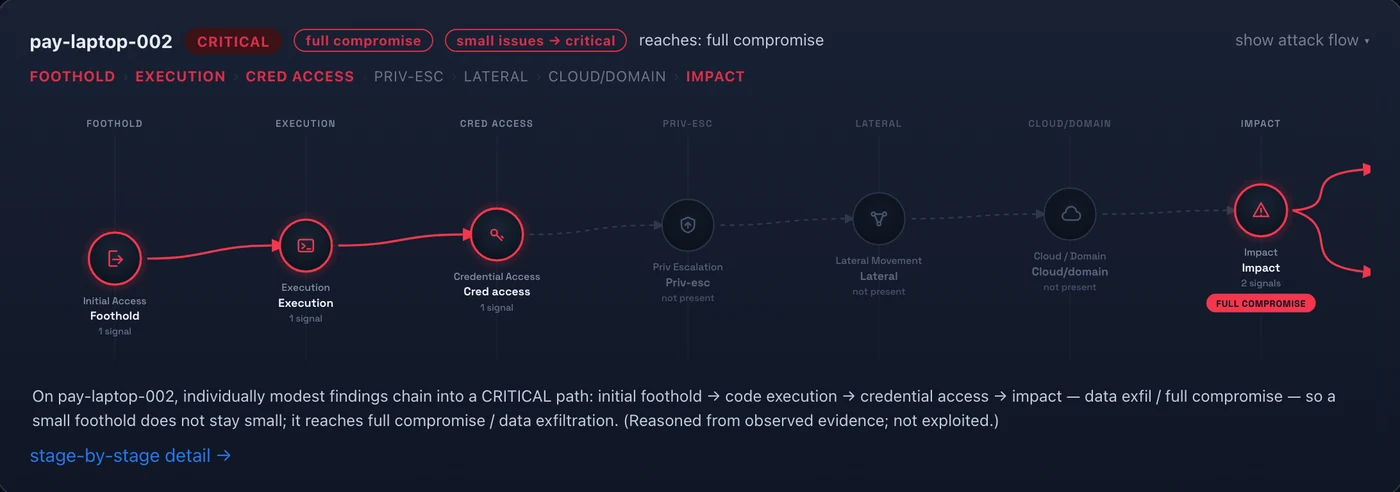
- A laptop
- Where the AI runs.
- An agent
- Running unattended.
- A tool server
- What the agent can call.
- A live key
- A credential on the same machine.
The finding shows the route and which step to cut. The same view runs from an agent on a cloud server to the data it can reach. How cloud attack paths work.
The industry figures behind the urgency
IBM's Cost of a Data Breach puts the global average cost of a breach at $4.99M in its 2026 edition, a record high, and found that high shadow AI added $670K to the average in its 2025 edition. Cyberhaven's 2025 AI Adoption & Risk Report found that 34.8% of the corporate data employees put into AI tools is sensitive, up from 10.7% two years earlier. Our own detection benchmark is on the research page.
Where each part is covered in full
- How Sargha differs from your EDR and cloud posture toolsWhat each tool inventories and what it leaves open.
- The control loopDiscover, rank, respond, test and govern, one stage at a time.
- Routing findings to ownersA fix list that goes to the owning team.
- The free assessmentRun the sensor on up to 25 endpoints and get a risk report and an AI Bill of Materials.
- Role viewsThe first screen for each role.
- Security and data handlingWhat the sensor collects, what leaves the machine and what it never collects.
- Sample reportsDownload the sample findings, executive summary and control reports.
What people ask before they start
The four questions we hear most. All questions.
How is this different from my EDR or CNAPP?
Your EDR hunts malware and your CNAPP checks cloud posture; neither inventories the AI your people actually adopted on their laptops. We build a live AI Bill of Materials (agents, SDKs, MCP servers, keys, egress) attributed to a machine and a person, and map it to the EU AI Act, NIST AI RMF and ISO 42001. We run alongside your EDR or CNAPP, not instead of them: more on that here.
How much of my estate does Sargha see?
Coverage is never 100%, and the report says which part is covered. Sargha reports, in five tiers, how much of your known estate it can see AI on, and names what stays outside: devices in no inventory, traffic off your network, and what a device does internally. See how coverage is measured.
What about false positives?
A deterministic engine scores findings. Inventory (an app on disk) is banded separately from active risk (a live key or a running agent), so you act on what matters instead of a flat list of MEDIUM findings. An optional AI reasoning layer adds advisory context and triages ambiguous cases; it never changes the deterministic score.
How does pricing work, and what counts as an endpoint?
Priced per endpoint per month on a one-year contract, billed annually, with volume tiers. An endpoint is any managed device running the sensor: laptop, desktop, server or VM. Each edition has an annual platform minimum. Start with a free assessment of up to 25 endpoints. See pricing or book a scoping call.
Get your AI risk report in about a week.
Run the sensor across your estate and receive an AI risk report and an AI Bill of Materials. The assessment is free and carries no commitment. You can also book a 30-minute call.